Scroll through social media, and you will keep seeing four-letter personality codes like INFP, INTJ, ENFJ and ESTP. When people talk about these personality labels, they are referring to MBTI, and 16Personalities is the most widely used MBTI-style 16 personality types assessment around the world.
For most people who start personality exploration, their first experience is an MBTI test on 16Personalities. With simple questions and easy-to-read reports, you can find your unique personality profile, including your strengths, weaknesses, love style and suitable development paths.
If you are curious about your personality type and want to use MBTI and 16Personalities as tools to understand yourself, this beginner guide will walk you through the core ideas of the 16 personality types and help you interpret your test results. You can take the free MBTI 16Personalities test here on 16Personalities CH and start your journey of self-discovery.
What are MBTI and 16Personalities?
MBTI, short for Myers-Briggs Type Indicator and also known as the 16 personality types system, is built on Carl Jung's theory of psychological types. It sorts human preferences into four core dimensions. Different combinations of these preferences create 16 distinct personality types, forming the foundation of the whole framework.
16Personalities is the well-known public assessment built around the MBTI framework. It simplifies the professional questionnaire and creates user-friendly reports covering personal growth, romantic relationships, workplace performance and social interactions. This is why the 16Personalities MBTI test has become so popular online.
In daily conversations, when someone says they are going to take an MBTI test, they usually mean the 16Personalities test.
The Four Core Dimensions of MBTI & 16Personalities
Whether you learn MBTI theory or complete the 16Personalities test, everything revolves around four preference pairs. These preferences describe your natural habits, not fixed abilities. They exist on a spectrum instead of being a strict either-or choice.
E Extraverted / I Introverted: Where you recharge your energy
- Extraverted (E): Gain energy from social interaction, group activities and the outer world. Connecting with others helps you feel refreshed.
- Introverted (I): Regain energy through quiet time and inner reflection. Long social gatherings drain your energy, and solitude helps you recharge.
Myth: Introversion does not equal social anxiety, and extraversion does not mean you are good at socializing. It only shows your energy source.
S Observant / N Intuitive: How you take in information
- Observant (S): Focus on concrete facts, real details and past experience. You trust what you can see and what has already happened.
- Intuitive (N): Notice patterns, hidden meanings, possibilities and future potential. You enjoy brainstorming and thinking about long-term ideas.
T Thinking / F Feeling: How you make decisions
- Thinking (T): Prioritize logic, rules, fairness and objective facts when making choices. You care more about whether something makes sense.
- Feeling (F): Prioritize values, people's emotions and relationship harmony. You consider how decisions will affect others.
Myth: Thinking types are not cold, and Feeling types are not overly emotional. They just follow different decision priorities.
J Judging / P Prospecting: How you organize your life
- Judging (J): Prefer plans, schedules and clear conclusions. You like arranging things ahead of time.
- Prospecting (P): Prefer flexibility, open options and spontaneous changes. You feel restricted by rigid fixed plans.
Myth: Judging does not equal perfectionism, and Prospecting does not equal procrastination. It is simply your preferred lifestyle rhythm.
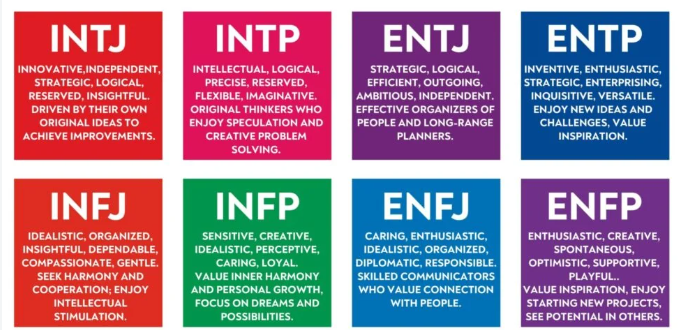
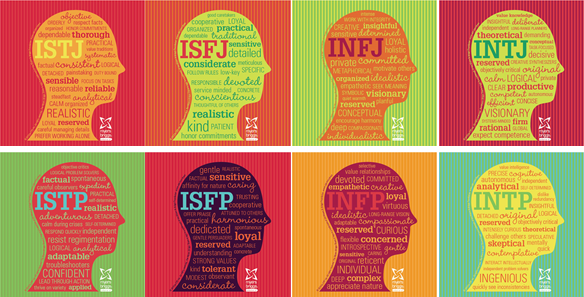
These four dimensions combine into the 16 well-known personality types: INFP, INTJ, INFJ, INTP, ENFP, ENTP, ENFJ, ENTJ, ISFP, ISTP, ISFJ, ISTJ, ESFP, ESTP, ESFJ and ESTJ. 16Personalities results also include an extra identity trait: A (Assertive) or T (Turbulent), describing your general emotional stability.
What Can You Learn From the MBTI 16Personalities Test?
Many people treat MBTI and 16Personalities only as fun online tags. But their real value is to reduce mental burnout and bring practical insight to daily life.
✓ Self-awareness: Accept yourself and know your strengths and blind spots
After receiving your MBTI 16Personalities report, you will understand which environments bring out your best performance, what triggers stress, your natural advantages and common pitfalls. The four-letter code is not a box to trap you. It helps you build on your strengths and accept that you are different from others.
♥ Romantic relationships: Understand your partner and reduce conflicts
MBTI and 16Personalities are widely used to improve communication in relationships. A Thinking person tends to solve problems with logic, while a Feeling person needs emotional comfort first. A Judging person wants fixed travel plans, while a Prospecting person loves spontaneity. Personality differences explain many arguments: it is not about who is wrong, but about different preferred communication styles.
◆ Career & workplace: Find an environment where you can thrive
The MBTI 16Personalities test cannot tell you exactly which job you must take. But it reveals your working style: do you work better independently or in teams? Do you prefer creative projects or structured routine work? You can reference your personality type when job hunting or switching careers to find a workplace that matches your natural style.
↔ Social life & teamwork: Embrace differences and collaborate better
In friendships, group projects and team management, every MBTI personality brings unique value. Some people see the big picture, others focus on details; some motivate the group, others stay calm and analyze risks. Learning the 16 personality types helps you respect diversity and build stronger collaboration.
Common Mistakes When Taking the MBTI 16Personalities Test
- Answer based on who you really are, not the ideal version of yourself. Choose answers matching your usual automatic behaviors, not how you wish to act. This makes your test result more accurate.
- Never rank personality types. There is no "best" or "elite" type. INTJ and INFP are not superior to other types. Every personality has its own strengths and growth lessons.
- Do not use your personality label as an excuse. Phrases like "I am P so I must procrastinate" or "I am I so I cannot join social events" are limiting. You can learn and develop skills outside your natural preferences.
- Treat results as a reference, not a final rule. Your personality can gradually shift as you gain life experience.
Conclusion
MBTI is the classic 16 personality types framework, and 16Personalities is the popular assessment that brings MBTI to millions of people around the world.
It works like a mirror, not a life sentence. We take the MBTI 16Personalities test not just to get a label, but to know ourselves more deeply and understand the people around us.
Coming soon: we will break down each of the 16 personality types one by one, covering traits, love preferences and career tips for popular types including INFP, INTJ and ENFP.
Ready to discover your personality?
Take the free MBTI 16Personalities test, get your full personality report, and start your self-exploration journey.
Take the free personality test →